Protocol version v5.1
This document specifies the wire protocol of Node Discovery v5.
Notation
Here we present the notation that is used throughout this document.
[ .. , .. , .. ]
is recursive encoding as an RLP list
a || b
means binary concatenation of a and b
xor(a, b)
means binary XOR of a and b
sha256(x)
is the SHA256 digest of x
aesctr_encrypt(key, iv, pt)
is unauthenticated AES/CTR symmetric encryption with the given key and iv.
Size of key and iv is 16 bytes (AES-128).
aesgcm_encrypt(key, nonce, pt, ad)
is AES-GCM encryption/authentication with the given key, nonce and additional
authenticated data ad. Size of key is 16 bytes (AES-128), size of nonce 12 bytes.
UDP Communication
Node discovery messages are sent as UDP datagrams. Since UDP is a lossy transport, packets may be received in any order or not at all. Implementations should not re-send packets if the recipient doesn’t respond.
The maximum size of any packet is 1280 bytes. Implementations should not generate or process packets larger than this size. Most messages are smaller than this limit by definition, the exception being the NODES message. FINDNODE returns up to 16 records, plus other data, and TOPICQUERY may also distribute a significantly long list of ENRs. As per specification the maximum size of an ENR is 300 bytes. A NODES message containing all FINDNODE response records would be at least 4800 bytes, not including additional data such as the header. To stay below the size limit, NODES responses are sent as multiple messages and specify the total number of responses in the message.
The minimum size of any Discovery v5 packet is 63 bytes. Implementations should reject packets smaller than this size.
Since low-latency communication is expected, implementations should place short timeouts on request/response interactions. Good timeout values are 500ms for a single request/response and 1s for the handshake.
When responding to a request, the response should be sent to the UDP envelope address of the request.
Packet Encoding
The protocol deals with three distinct kinds of packets:
- Ordinary message packets, which carry an encrypted/authenticated message.
- WHOAREYOU packets, which are sent when the recipient of an ordinary message packet cannot decrypt/authenticate the packet’s message.
- Handshake message packets, which are sent following WHOAREYOU. These packets establish a new session and carry handshake-related data in addition to the encrypted/authenticated message.
In the following definitions, we assume that the sender of a packet has knowledge of its
own 256-bit node ID (src-id) and the node ID of the packet destination (dest-id). When
sending any packet except WHOAREYOU, the sender also generates a unique 96-bit nonce
value.
Protocol Header
All discovery packets contain a header followed by an optional encrypted and authenticated message.
Header information is ‘masked’ using symmetric encryption in order to avoid static identification of the protocol by firewalls.
packet        = masking-iv || masked-header || message
masked-header = aesctr_encrypt(masking-key, masking-iv, header)
masking-key   = dest-id[:16]
masking-iv    = uint128   -- random data unique to packet
The masked-header contains the actual packet header, which starts with a fixed-size
static-header, followed by a variable-length authdata section (of size authdata-size).
header        = static-header || authdata
static-header = protocol-id || version || flag || nonce || authdata-size
protocol-id   = "discv5"
version       = 0x0001
authdata-size = uint16    -- byte length of authdata
flag          = uint8     -- packet type identifier
nonce         = uint96    -- nonce of message
Decrypting the masked header data works as follows: The recipient constructs an AES/CTR
stream cipher using its own node ID (dest-id) as the key and taking the IV from the
packet. It can then decrypt the static-header and verify that protocol-id matches the
expected string. If it does, the recipient can read authdata-size and unmask the
remaining authdata.
Implementations should not respond to packets with mismatching protocol-id.
In ordinary message packets and handshake message packets, the packet contains an
authenticated message after the authdata section. For WHOAREYOU packets, the message
is empty. Implementations must generate a unique nonce value for every message packet.
message       = aesgcm_encrypt(initiator-key, nonce, message-pt, message-ad)
message-pt    = message-type || message-data
message-ad    = masking-iv || header
The flag field of the header identifies the kind of packet and determines the encoding
of authdata, which differs depending on the packet type.
Ordinary Message Packet (flag = 0)
For message packets, the authdata section is just the source node ID.
authdata      = src-id
authdata-size = 32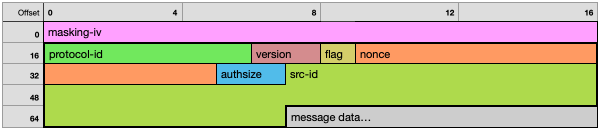
WHOAREYOU Packet (flag = 1)
In WHOAREYOU packets, the authdata section contains information for the identity
verification procedure. The message part of WHOAREYOU packets is always empty. The
nonce part of the packet must be set to the nonce of the message packet that caused
the WHOAREYOU response.
authdata      = id-nonce || enr-seq
authdata-size = 24
id-nonce      = uint128   -- random bytes
enr-seq       = uint64    -- ENR sequence number of the requesting node
Handshake Message Packet (flag = 2)
For handshake message packets, the authdata section has variable size since public key
and signature sizes depend on the ENR identity scheme. For the “v4” identity scheme, we
assume 64-byte signature size and 33 bytes of (compressed) public key size.
authdata starts with a fixed-size authdata-head component, followed by the ID
signature, ephemeral public key and optional node record.
The record field may be omitted if the enr-seq of WHOAREYOU is recent enough, i.e.
when it matches the current sequence number of the sending node. If enr-seq is zero, the
record must be sent. Node records are encoded and verified as specified in EIP-778.
Please refer to the handshake section for more information about the content of the handshake packet.
authdata      = authdata-head || id-signature || eph-pubkey || record
authdata-head = src-id || sig-size || eph-key-size
authdata-size = 34 + sig-size + eph-key-size + len(record)
sig-size      = uint8     -- value: 64 for ID scheme "v4"
eph-key-size  = uint8     -- value: 33 for ID scheme "v4"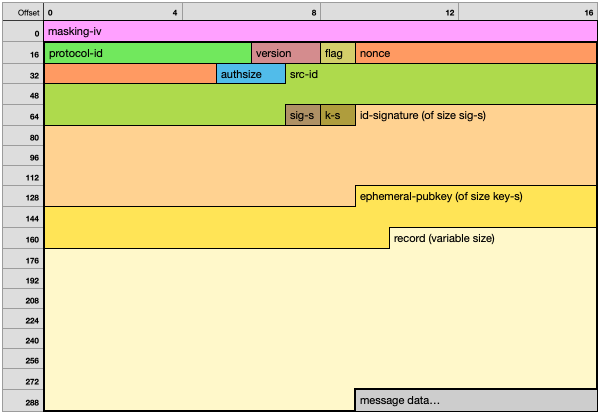
Protocol Messages
This section lists all defined messages which can be sent and received. The hexadecimal
value in parentheses is the message-type.
The first element of every message-data list is the request ID. request-id is an RLP
byte array of length <= 8 bytes. For requests, this value is assigned by the requester.
The recipient of a message must mirror the value in the request-id element of the
response. The selection of appropriate values for request IDs is left to the implementation.
PING Request (0x01)
message-data = [request-id, enr-seq]
message-type = 0x01
enr-seq      = local ENR sequence number of sender
PING checks whether the recipient is alive and informs it about the sender’s ENR sequence number.
PONG Response (0x02)
message-data   = [request-id, enr-seq, recipient-ip, recipient-port]
message-type   = 0x02
enr-seq        = ENR sequence number of sender
recipient-ip   = 16 or 4 byte IP address of the intended recipient
recipient-port = recipient UDP port, a 16-bit integer
PONG is the reply to PING.
FINDNODE Request (0x03)
message-data = [request-id, [distance₁, distance₂, ..., distanceₙ]]
message-type = 0x03
distanceₙ    = requested log2 distance, a positive integer
FINDNODE queries for nodes at the given logarithmic distances from the recipient’s node
ID. When distance 0 is requested, the result set should contain the recipient’s current
record.
The recipient should create the result set by collecting nodes from its local node table according to the requested distances. Implementations should limit the number of nodes in the result set. The recommended result limit for FINDNODE queries is 16 nodes.
NODES Response (0x04)
message-data = [request-id, total, [ENR, ...]]
message-type = 0x04
total        = total number of responses to the request
NODES is sent as a response to FINDNODE, REGTOPIC, or TOPICQUERY. Multiple NODES messages
may be sent as responses to a single query. Implementations may place a limit on the
allowed maximum for total. If exceeded, additional responses may be ignored.
When handling NODES as a response to FINDNODE, the recipient should verify that the received nodes match the requested distances.
When NODES appears as a response to REGTOPIC or TOPICQUERY, it carries auxiliary ENRs
selected from the responder’s view of the service table for the requested topic. These
ENRs are routing information for the requester to populate or refresh its own service
table B(s). They are not themselves topic registrants; the actual registered nodes are
returned via TOPICNODES.
TALKREQ Request (0x05)
message-data = [request-id, protocol, request]
message-type = 0x05
TALKREQ sends an application-level request. The purpose of this message is pre-negotiating
connections made through another application-specific protocol identified by protocol.
protocol and request are RLP byte arrays.
The recipient must respond with a TALKRESP message containing the response to the request.
If the protocol is unknown to the recipient, it must respond with a TALKRESP response
containing empty response data.
TALKRESP Response (0x06)
message-data = [request-id, response]
message-type = 0x06
request-id   = request-id of TALKREQ
TALKRESP is the response to TALKREQ. The response is a RLP byte array containing the
response data.
REGTOPIC Request (0x07)
message-data    = [request-id, topic, ENR, ticket,
                   [topic-distance₁, topic-distance₂, ..., topic-distanceₙ]]
message-type    = 0x07
topic           = 32-byte service / topic identifier
ENR             = current node record of sender
ticket          = opaque byte array containing a ticket previously issued by the
                  recipient registrar; empty (`0x80`) on first attempt
topic-distanceₙ = positive integer log2 distance from `topic` where the sender's
                  service table `B(topic)` still has space
REGTOPIC asks the recipient registrar to register the sender (identified by ENR) for
service topic. If the sender has a ticket from a previous registration attempt with this
registrar, it must present the ticket; otherwise ticket is the empty byte array.
The topic-distance list carries the sender’s “send me ENRs at these distances” hint to
the recipient: when returning auxiliary ENRs, the recipient should prefer ENRs whose log2
distance to topic matches one of the listed values, so the response helps the sender
populate its service table.
REGTOPIC is always answered with a single REGCONFIRMATION response. The recipient may additionally send zero or more NODES responses carrying auxiliary ENRs selected from its view of the service table.
See the theory section on tickets and theory section on registrar admission control for the registrar’s waiting-time semantics.
REGCONFIRMATION Response (0x08)
message-data = [request-id, total, ticket, wait-time]
message-type = 0x08
request-id   = request-id of REGTOPIC
total        = total number of responses (REGCONFIRMATION + NODES) to the request
ticket       = ticket issued by the registrar for the next attempt;
               empty byte array (RLP: `0x80`) when the registration was admitted
wait-time    = milliseconds to wait before submitting the next REGTOPIC attempt
               with the returned `ticket`. When `ticket` is empty, `wait-time` carries
               the advertisement lifetime instead.
REGCONFIRMATION is the response to REGTOPIC. It is sent immediately by the registrar and
plays two roles, distinguished by the length of ticket:
- If
ticketis the empty byte array, the advertisement has been admitted to the registrar’s ad cache.wait-timeindicates the advertisement lifetime; the advertiser should renew before that lifetime elapses to remain in the cache. - If
ticketis non-empty, the advertisement was not admitted on this attempt. The sender must wait at leastwait-timemilliseconds and re-attempt the registration with the returnedticket. See the theory section on tickets and the theory section on the waiting-time function.
The total field announces the total number of responses (this REGCONFIRMATION plus any
NODES messages carrying auxiliary ENRs) that the registrar will send for this request.
TOPICQUERY Request (0x09)
message-data    = [request-id, topic,
                   [topic-distance₁, topic-distance₂, ..., topic-distanceₙ]]
message-type    = 0x09
topic           = 32-byte service / topic identifier
topic-distanceₙ = positive integer log2 distance from `topic` where the sender's
                  service table `B(topic)` still has space
TOPICQUERY asks the recipient to return registered advertisers for the given topic from
its ad cache. The recipient sends zero or more TOPICNODES responses containing matching
advertiser ENRs, and may additionally send zero or more NODES responses carrying
auxiliary ENRs selected from its service-table view (see NODES).
The topic-distance list serves the same purpose as in REGTOPIC: it tells the recipient
which log2 distances from topic the sender’s service table still has room for, so the
recipient can choose useful auxiliary ENRs to include in its NODES responses.
See the theory section on lookup responses for the discoverer-side termination semantics
(distinct-advertisers count) and the theory section on parameters for Freturn.
TOPICNODES Response (0x0A)
message-data = [request-id, total, [ENR, ...]]
message-type = 0x0a
request-id   = request-id of TOPICQUERY
total        = total number of responses (NODES + TOPICNODES) to the request
TOPICNODES is the dedicated response to TOPICQUERY carrying advertiser ENRs that are currently registered for the requested topic in the recipient’s ad cache. Multiple TOPICNODES messages may be sent for a single TOPICQUERY.
The total field announces the total number of responses (TOPICNODES messages plus any
NODES messages carrying auxiliary ENRs) the recipient will send for this request.
Implementations may place a limit on the allowed maximum for total; if exceeded,
additional responses may be ignored.
The recipient should return only non-expired advertisements from its ad cache. When the
ad cache contains more than Freturn advertisements for the topic, the recipient
selects which advertisements to return; the exact selection policy is implementation
defined.
TOPICNODES carries only registered advertisers. Auxiliary routing information for the sender’s service table is carried separately via NODES responses.
Test Vectors
A collection of test vectors for this specification can be found at discv5 wire test vectors.